| What is Craft Bookbinding? |
|
| Everyone is familiar with commercially produced books available in bookshops and libraries. They are made in large quantities on a production line and are hardly touched by hand. |
| It was not always so. For hundreds of years, books, including the paper, were made by hand using methods that had stood the test of time to produce sturdy, long lasting volumes. |
| With the advent of the Industrial Age and increasing literacy, it became necessary to produce cheaper books in larger quantities, and so machines were invented to take over the hand operations. Unfortunately, the mechanical methods were not as good as hand methods, and they slowly deteriorated until we now have books, many of which, though cheap, have to be held open to read and lose pages when first read. |
| Craft bookbinders have preserved the old hand binding methods and use them to make soundly constructed, easily read and long lasting single books. |
| They also create beautiful, unique books bound in leather, cloth or paper called ‘fine bindings’. |
| The same techniques are used to restore and repair old books, and today, a knowledge of traditional methods proves extremely valuable to book artists who practise a craft which is becoming more and more popular. |
| The following are some examples of books and book arts created by members of the Guild. |
|
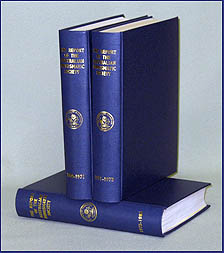
A 'case binding' of newsletters |
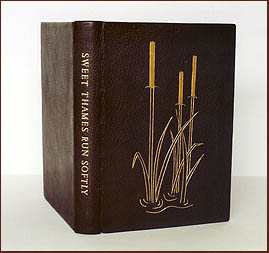
A 'fine binding' in leather |
|
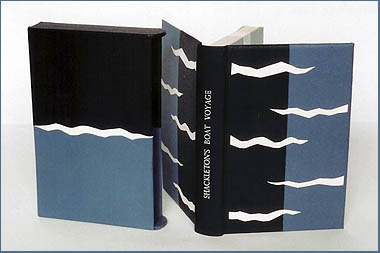
A 'fine binding' in cloth (buckram) with slip case |
|
|
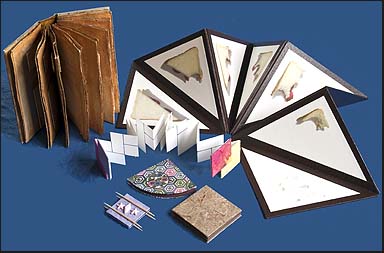
Examples of artists' books |
|
|
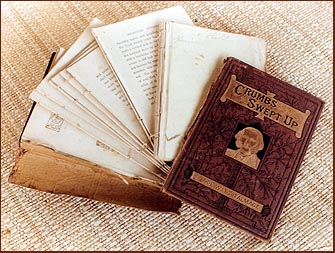
Restoration of a badly damaged binding - before ... |
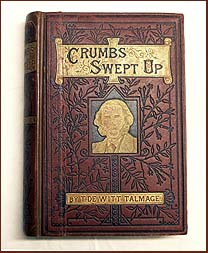
and after |
|
|